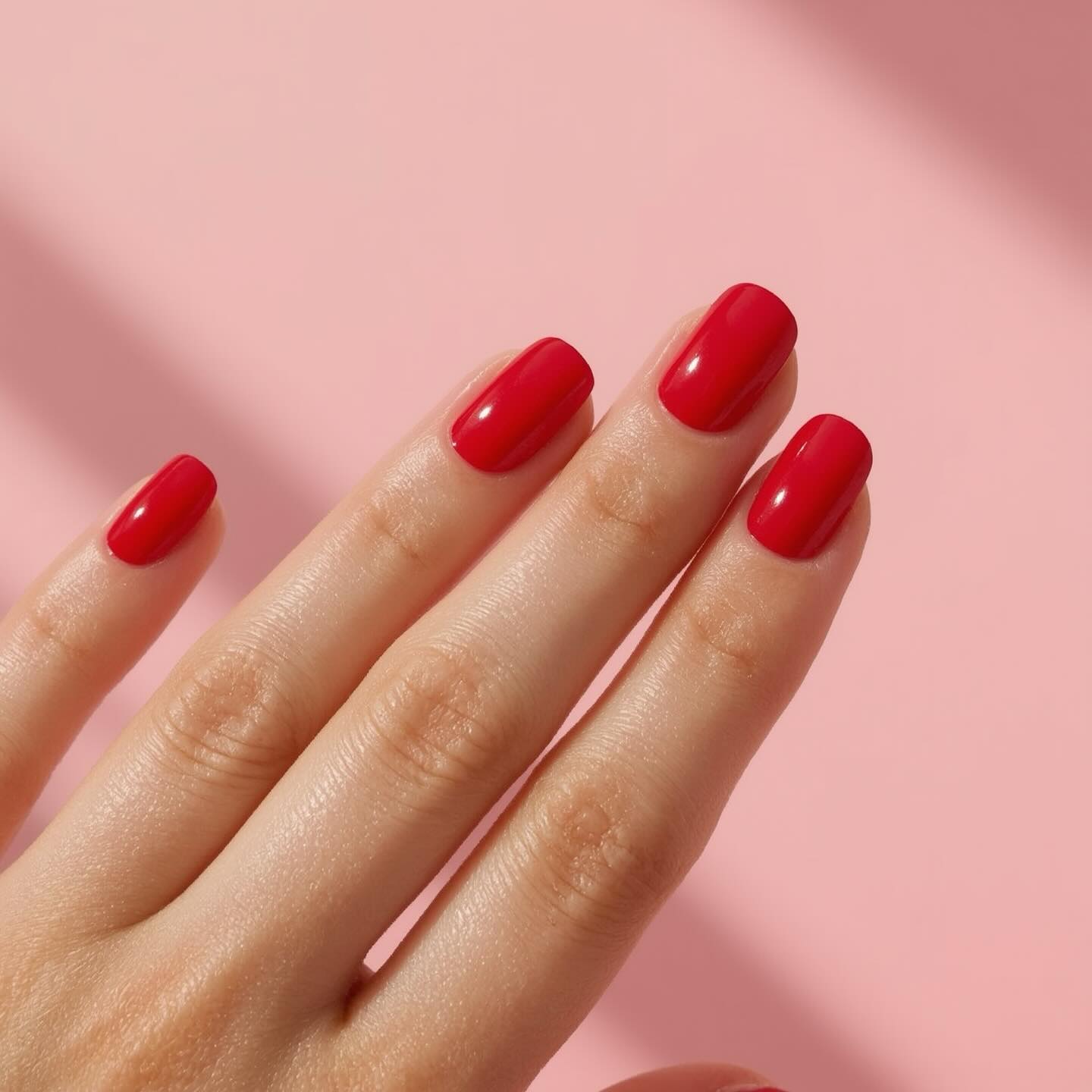
Gel overlay on natural nails: what it is and who it makes sense for

A natural nail overlay is a layer of gel on your own nail that does not make it longer but evens out its surface and gives the colour a smooth, firm base, and because the nail keeps growing underneath, it is refilled every few weeks. It makes sense if you want short nails with gel colour and are happy with regular studio appointments. The firmness comes from the gel, not from the nail underneath, so if you want your own nails to recover, an overlay is not the right choice. At Anni Nails in Meidling, Vienna, the natural nail overlay is done only on short nails and without extensions.
What a natural nail overlay is
With an overlay your own nail sets the length, so there are no glued-on tips and no forms underneath as there usually are with extensions. The gel goes on in one or more layers and each layer is set under a lamp, because according to the American Academy of Dermatology (AAD), the US professional association for dermatologists, gel nails need UV light to harden (the AAD on artificial nails).
An overlay differs from gel polish in the amount of material: gel polish is a thin layer of colour, while an overlay builds up enough gel to even out thin or uneven areas, with the gel colour or a French on top.
Who it makes sense for and who it does not
A gel overlay on natural nails suits you if you keep your nails short and want gel colour on a smooth surface, even if your own nails are not completely even. It is less suitable if your nails are already thin and brittle and you want them to recover. According to the AAD, gel nails are more flexible than acrylic nails but can still leave nails brittle, peeling and cracked. The AAD also advises wearing artificial nails only for special occasions, because the time without them gives your nails a chance to recover. The article A break from gel nails explains how long such a break should last.
Refilling a gel overlay: why and how often
The nail keeps growing under the gel, by about three millimetres a month according to Cleveland Clinic (Cleveland Clinic on nail anatomy), so a strip without gel gradually appears at the base of the nail. For artificial nails, the AAD mentions touch-ups every two to three weeks to fill the gaps that appear as the nails grow, and also warns that frequent touch-ups can seriously damage the natural nail.
At a refill, the old gel is usually not taken off completely but shortened and filed thinner, then the regrowth at the base is levelled with new gel and fresh colour goes on top. What matters is that only the old gel is worked on, not the natural nail underneath. The AAD describes the problem using acrylic nails as an example: when the surface of the natural nail is filed until it feels rough, the nail becomes thinner and weaker.
If the gel starts to come off between appointments, the AAD advises not to pick at it or prise it off with another nail or a tool, but to make an appointment and have it removed at the salon (the AAD on gel manicures).
Care between appointments
In the meantime, you can follow the general advice in the AAD's tips for healthy nails:
- Wear gloves when cleaning and washing up, because too much water can weaken your nails so that they split, peel or break.
- Moisturise your hands after washing them.
- Do not bite your nails or remove your cuticles, because this can damage the nail.
- Do not use your nails as tools, for example to open drink cans, because they can chip, split or come away from the nail bed.
Having the overlay removed gently
If you no longer want the overlay or would like a break, it is best to have the gel removed at a salon rather than pulling it off yourself, because according to the AAD, picking or filing off gel polish can do considerable damage to your nails (the AAD on removing gel polish). Gentle removal mainly means working without force and not filing into the natural nail. How to care for the natural nail afterwards, and what to watch out for if you do take the gel off at home, is covered in the article Gel nail removal.
UV lamps and allergies: what to know beforehand
According to the AAD, repeated gel manicures can increase the risk of skin cancer and premature skin ageing on the hands, so it advises applying a water-resistant, broad-spectrum sunscreen with SPF 30 or higher to your hands before a gel manicure, or wearing dark, opaque gloves with the fingertips cut off.
Gel nails, gel polish and acrylic nails contain acrylates, and some people are allergic to these substances. According to the British Association of Dermatologists (BAD), this kind of allergy can develop when uncured product comes into contact with the skin, and at-home kits can be riskier because non-professionals have little experience with these products (BAD, 2023). The BAD also points out that the same or very similar methacrylates are used in white dental fillings, for example, so an allergy like this can have serious consequences for later medical treatment.
When to see a dermatologist
The AAD advises having your nails looked at by a dermatologist if they change, swell or hurt, because these can be signs of serious nail problems. In that case, see a dermatologist instead of having new gel applied, for example if
- the skin around a nail is red or swollen, hurts or produces pus,
- a nail changes colour or becomes thicker,
- a nail lifts off the nail bed,
- your fingertips crack or the nail fold is inflamed,
- eczema appears on your eyelids, around your mouth, on your chin or on the sides of your neck.
Apart from the first point, the British organisation Eczema UK lists all of these as signs of an allergic reaction to acrylic nails, and it counts gel nails and gel polish among the products containing acrylates. A patch test at a dermatologist's practice can show which substance is responsible (Eczema UK on nail allergies).
Natural nail overlays at Anni Nails in Vienna
At Anni Nails, the overlay is part of "Gel Refill + Manicure (short & medium length)", which includes a manicure, the gel refill, levelling and reinforcing the natural nail, and a single-colour gel or a French. It takes about two and a half hours and costs €60. Anastasia works only with short nails (size S) and does not do extensions, so if you are looking for gel nails with extensions in Vienna, Anni Nails does not offer them.
For taking it off there is "Gel Removal", in which about 70 per cent of the material is taken off with a drill down to the base layer and the remaining 30 per cent is softened and carefully removed so that the natural nail is not damaged. Finally a nourishing serum treatment goes on the nails, and the whole treatment takes about an hour and costs €25, with no manicure included.
Anastasia has been doing manicures for more than ten years and works without aggressive techniques, and every treatment includes a personal consultation on caring for your nails and the skin on your hands. Please mention any allergies, skin conditions or health concerns before the treatment. If you are not sure which treatment suits your nails, for example because you have not worn gel before, you can ask in advance by phone or WhatsApp on +43 677 61407186.
The studio is at Schönbrunner Straße 253, 1120 Vienna, and is open from 9 am to 8 pm Monday to Saturday and on Sundays on request. All treatments and their prices are listed under Services and prices, and you can find a free slot online under Book an appointment.